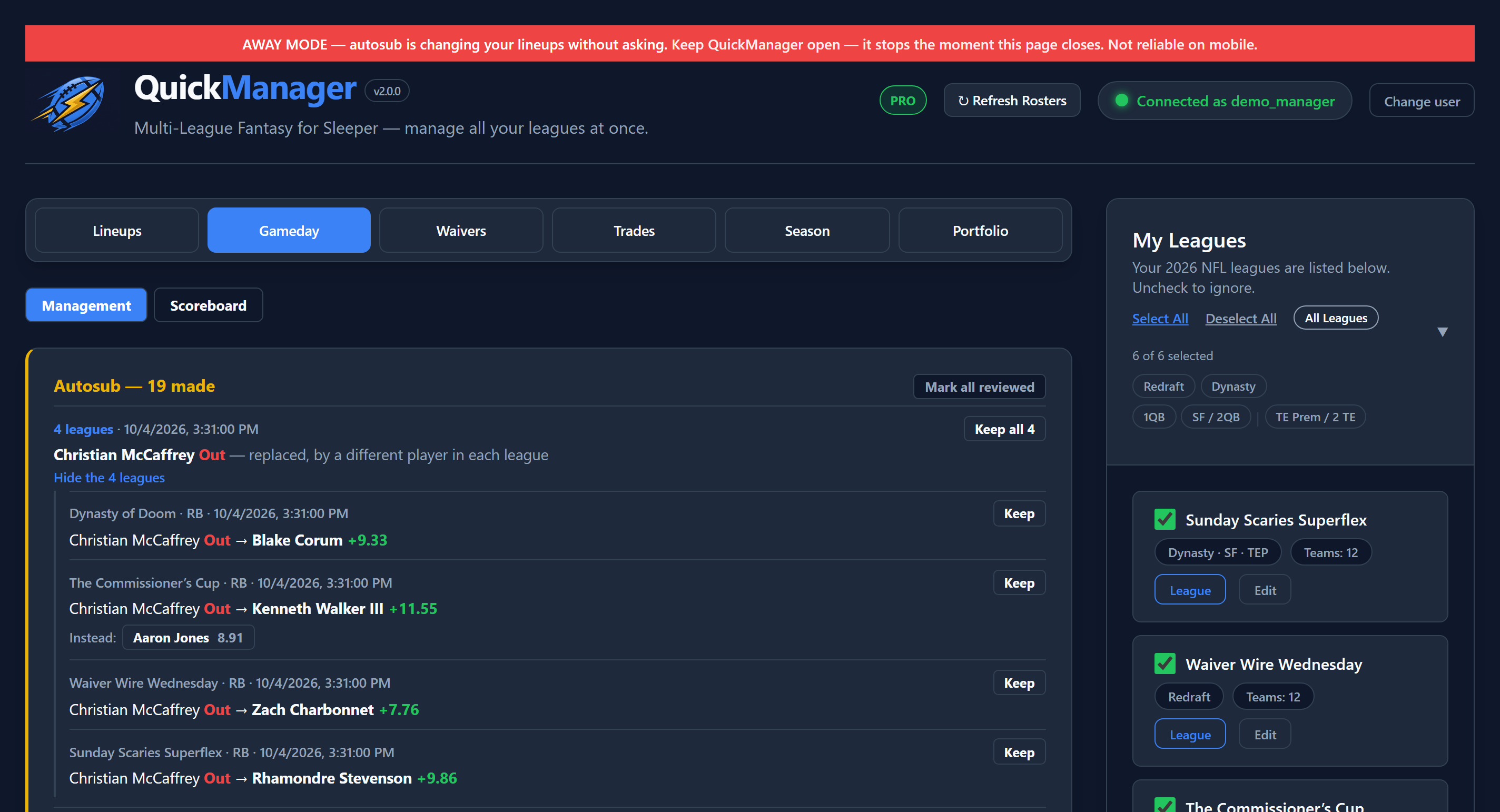
QuickManager scans all your leagues at once — optimal lineups, waiver targets, and trades — so a Sunday morning routine that used to take twelve tabs takes one click.
Managing one Sleeper league is easy. Managing ten is a chore. QuickManager turns hours of repetitive, league-by-league clicking into a few clicks that run everywhere you play.
Scan every league at once and see exactly how many points you're leaving on the bench. Pick a week, review the swaps, apply optimal lineups everywhere with one click. Bye weeks and projections are handled automatically. Optionally prioritize your latest-kickoff players into FLEX spots, so you can still pivot as early games wrap up.
Add the players you want this week to one target list, and see where each is gettable across every league at once. Every claim it builds is fully editable — change the drop from a dropdown, or add your own fallback attempt if your first plan doesn't land. Manage claims you've already submitted right there too, with a true total exposure number against your budget. Free Agent Radar and Mass Drop round it out — surface the best unowned players, or cut a flier from every roster you added them to in one action.
Define a trade and scan every league for valid partners. Review every pending offer across all your leagues in one place — accept, decline, counter, or withdraw without hunting league by league.
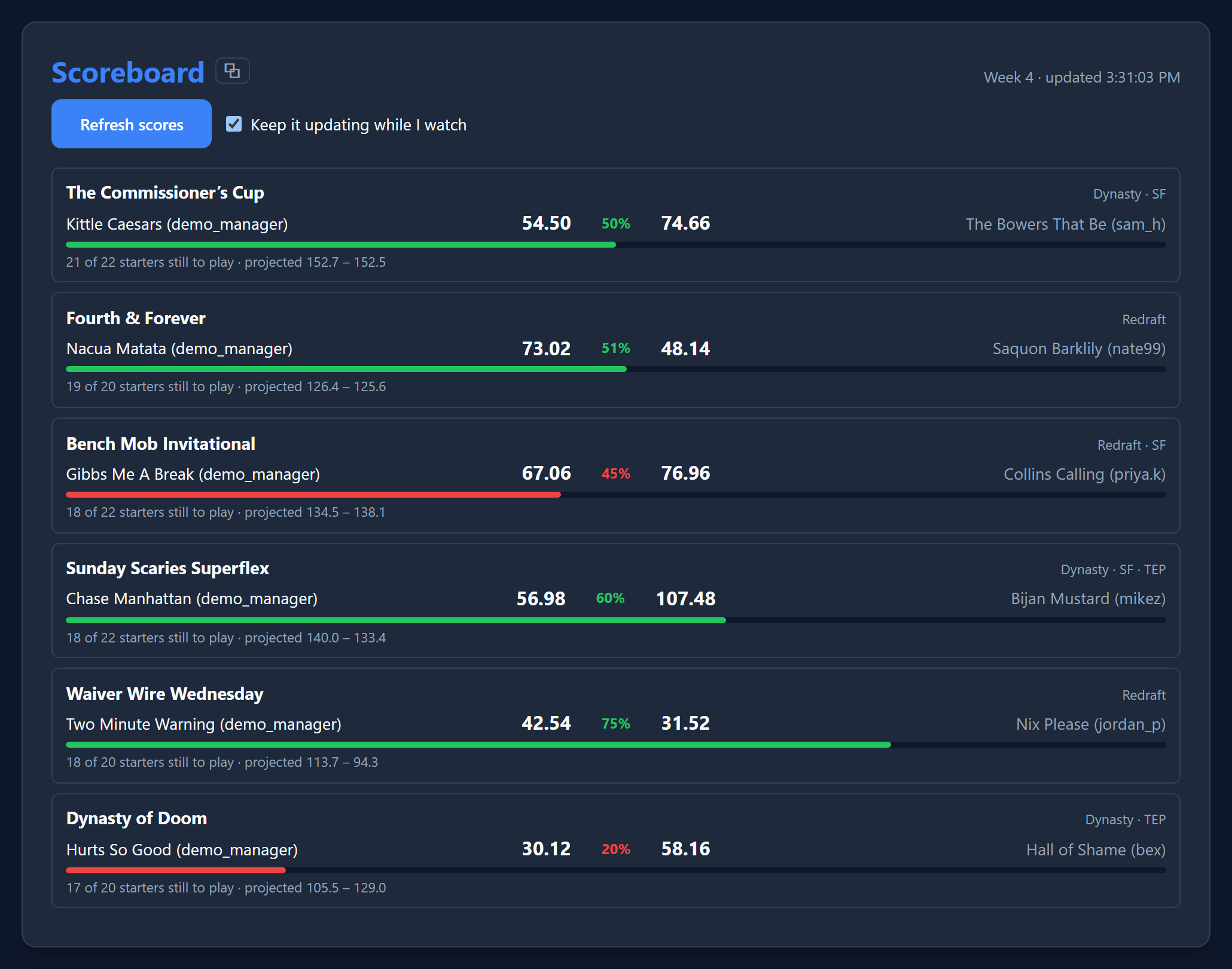
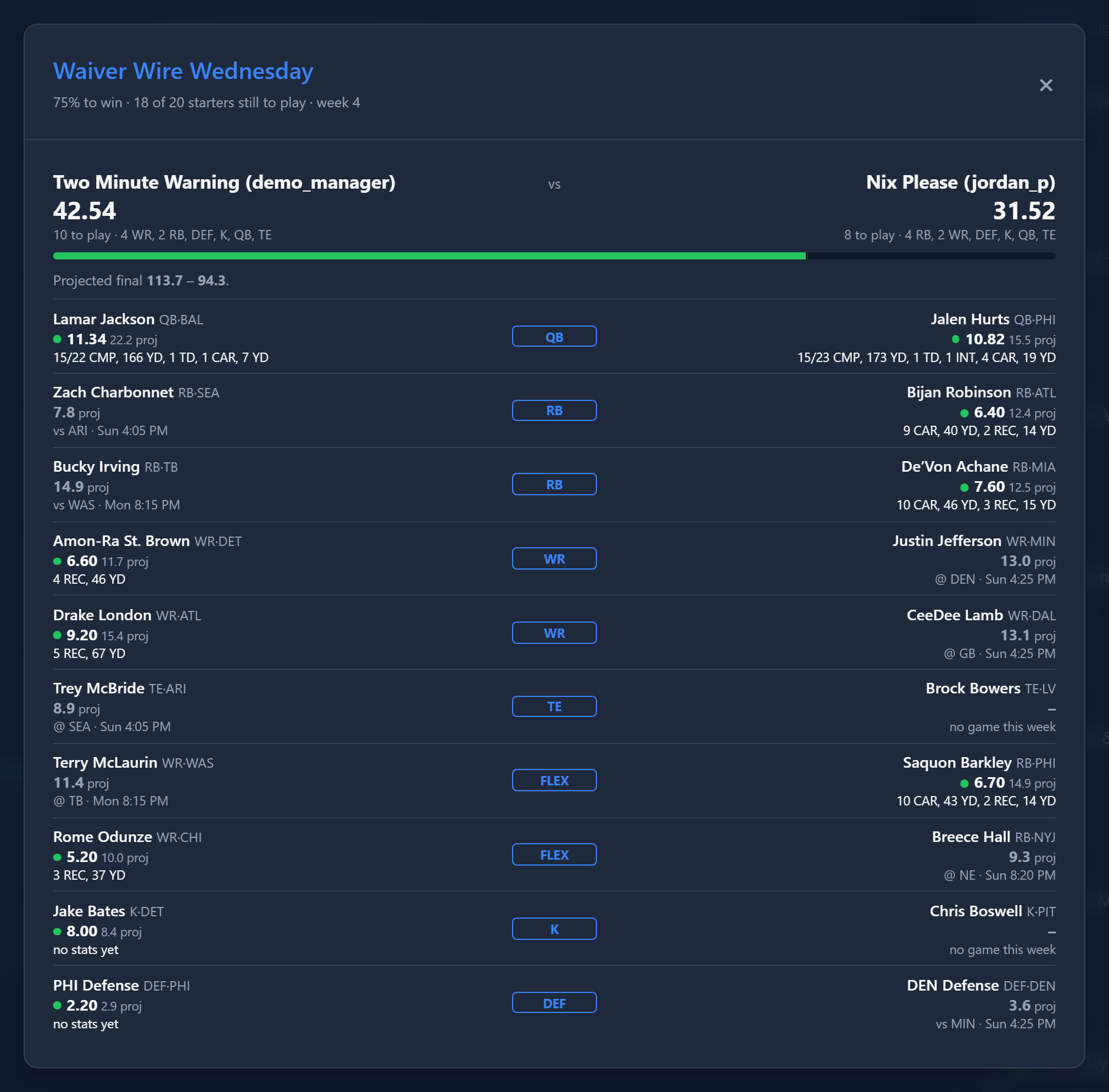
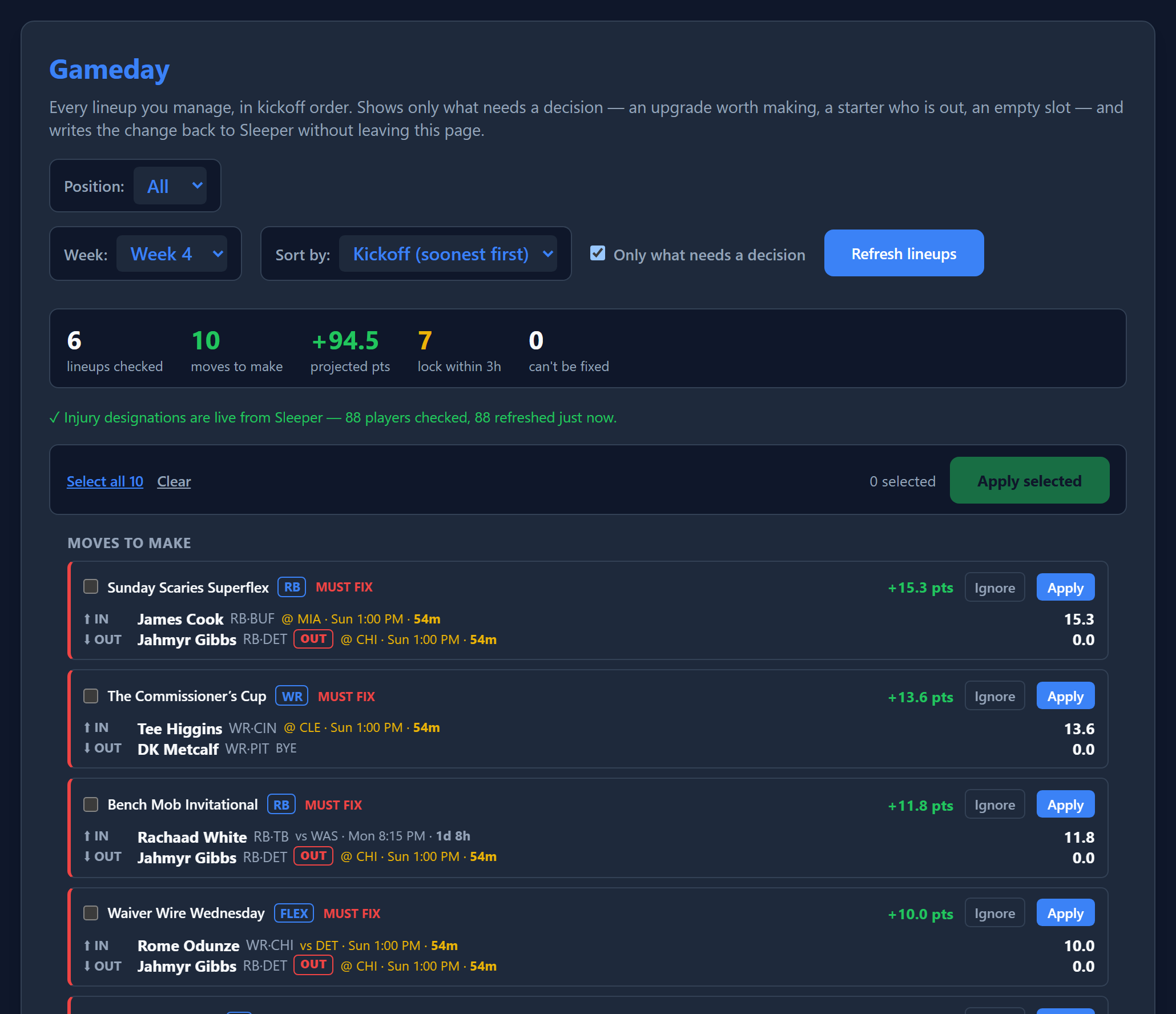
See this week's matchup and win probability everywhere at once, then simulate the rest of the season thousands of times for real playoff odds and a positional breakdown against the league. The Player Portfolio adds the gameday pass: every lineup you manage, in kickoff order, showing only the ones that still need a decision.
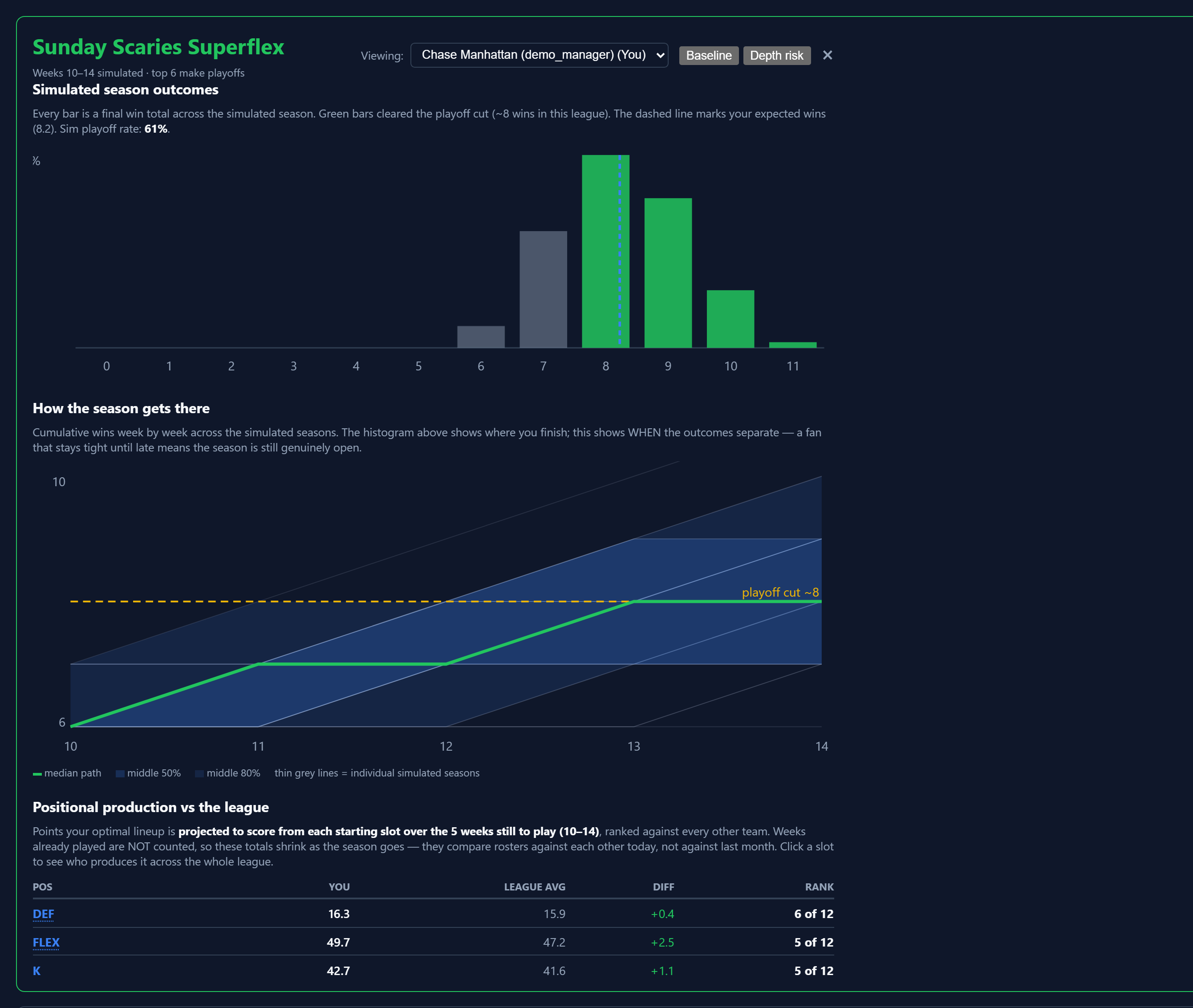
Every screenshot below is the real interface, not a mockup. Most are live runs against real leagues; the positional breakdown uses a sample one so nobody else’s team names end up on this page.
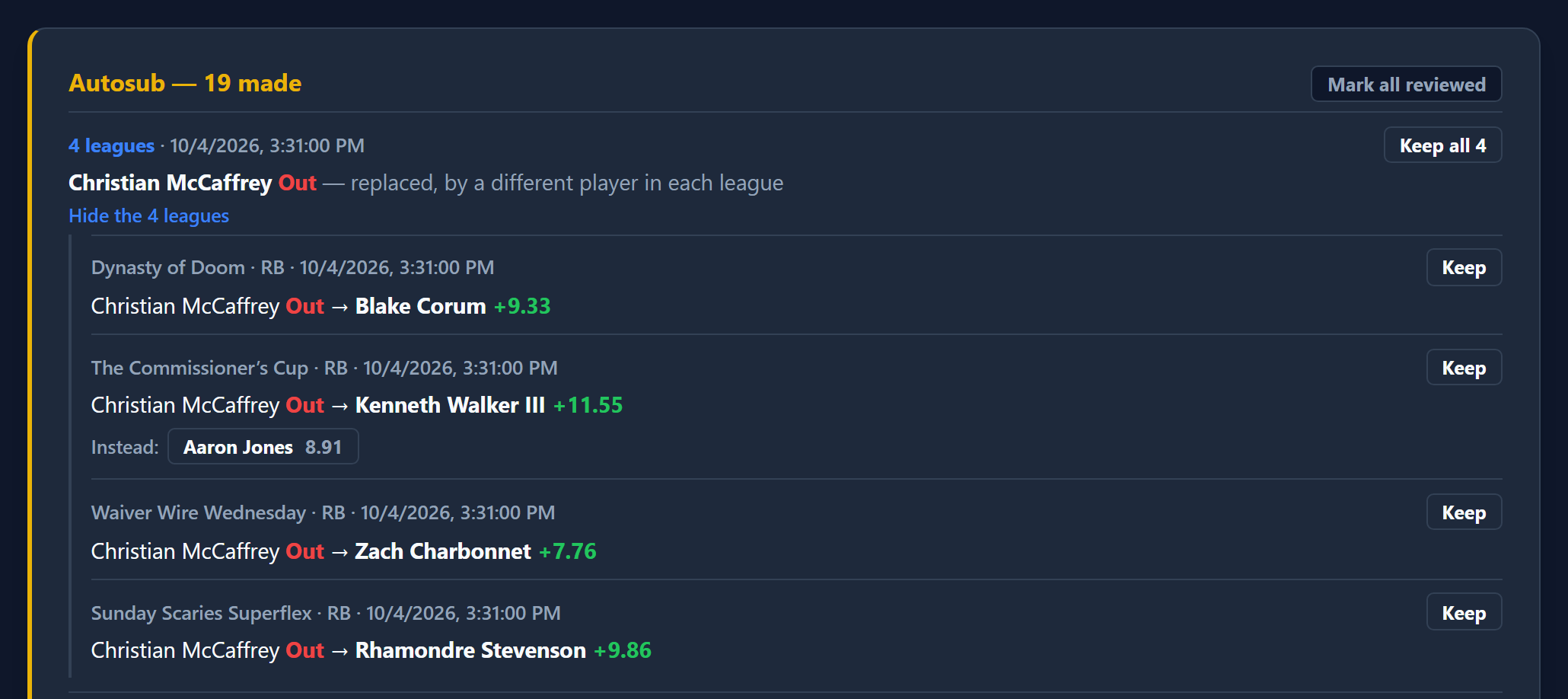
Each swap shows the real points gained or lost — never a fake number from two players simply changing slot labels. If nothing about the lineup's value actually changed, it says so plainly instead of inventing a trade that didn't happen.

See this week's matchup and win probability for every league at once, then run a full season simulation to find which leagues are still genuinely in play. A cross-league table ranks every roster by how much attention is actually worth spending on it right now.

A fan chart of every simulated path shows exactly when your season's outcomes actually separate, with the real playoff cut line drawn in from the simulation itself. A positional table ranks your team against the rest of the league at every position, so you know precisely what to go fix.
Any run saves to a single file you can keep. One click writes the whole thing — charts, tables and the positional breakdown — to one self-contained HTML page that still works offline, with nothing to install to open it. Send it to a leaguemate, keep it as a record of where week 10 stood, or open it next season.
Open a saved run → Real export, invented leagues — nobody else’s team names.
See your real cross-league exposure to any one player — who you're most riding on, and which of those leagues are actually still live. Age context flags players entering, past, or well beyond their typical prime, without ever predicting what they'll do next.

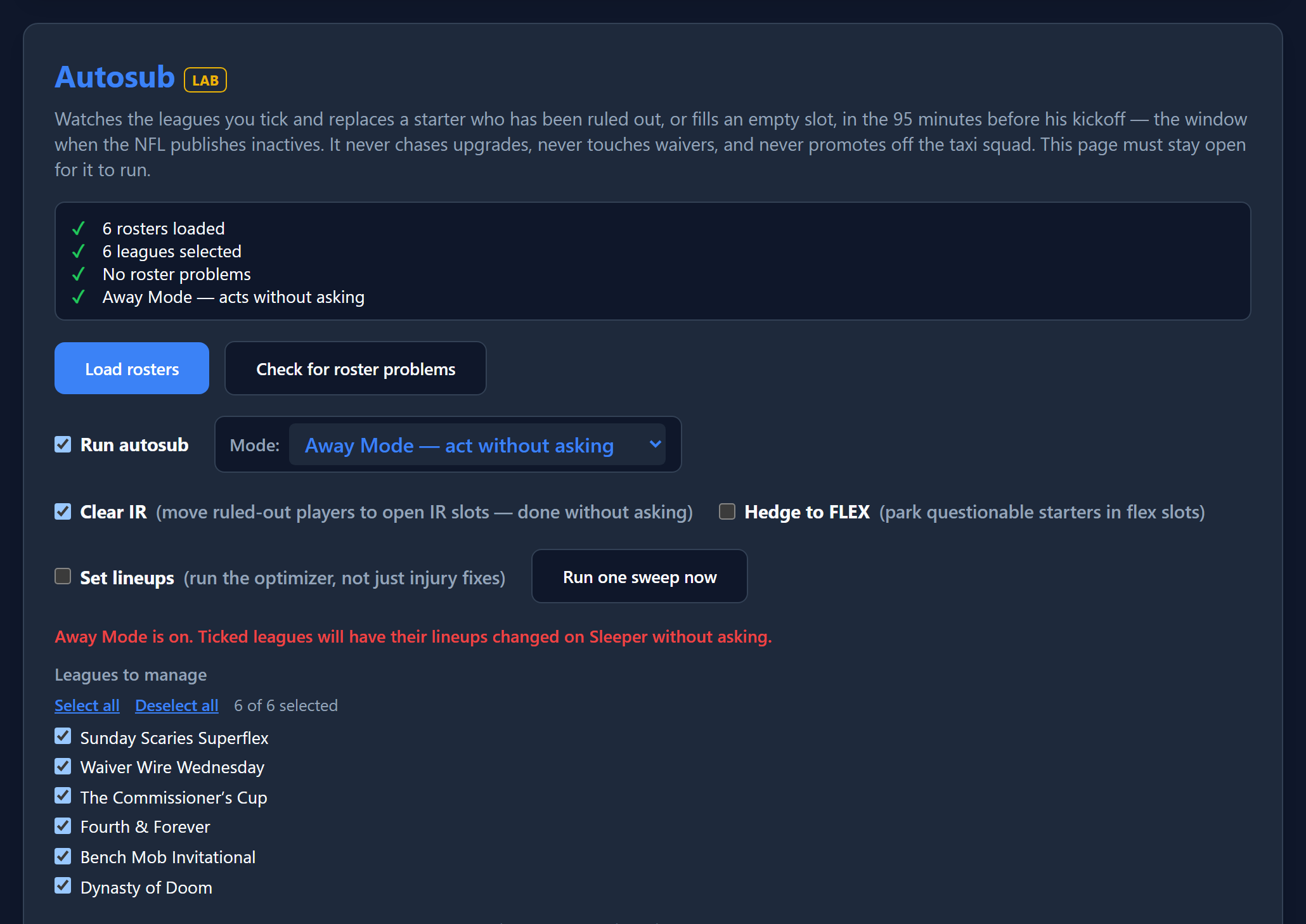
Sunday morning, a dozen teams, not much time. This finds the two or three lineups that actually need a click and stays quiet about the rest — an upgrade worth making, a starter who's been ruled out, an empty slot — then writes the change back to Sleeper without leaving the page.

Free Agent Radar scans the whole player pool for standouts — filter by position or NFL team, include already-rostered players to scout trade targets, and add anyone straight to the Waiver Board. Manage every pending claim across every league without hunting league by league.

Before pulling the trigger on a trade, run a two-sided Monte Carlo simulation. QuickManager isolates exactly how a trade impacts both teams' playoff odds, and its optional depth-injury model reveals the hidden fragility in trading a star for scrubs.

Click any position in a league's simulation and the whole league opens up in that one slot: every manager ranked by what it is projected to produce, with the players carrying it listed beside them. Sort by any column to flip the question around.

A big round of interface work ahead of kickoff — the screens you'll live in on a Sunday, rebuilt around what you actually do with them.
Every position in a simulated league is now a link. Open one and you get the entire league ranked by that slot's projected production, each manager sitting next to the players carrying it — sortable by any column. The number of contributors matches the number of starters your league actually uses, and SUPERFLEX is ranked on its own rather than folded into FLEX, so a superflex league finally reads the way it plays.
Point the simulator at a specific manager and their roster becomes a selectable list, their draft picks come into play, and you can send the offer without rebuilding it somewhere else — with a DM attached if you want one. Everything the extension sends now stops at a summary of what's moving each way, so nothing reaches Sleeper you haven't read.
Export your starters one row per team, per slot, per contributing player — as a flat CSV, or as a spreadsheet with each league on its own sheet and the numbers left as numbers so they sort and chart. The saved HTML page carries the positional breakdown with it too.
Teams and managers are named together, in one consistent format, everywhere the extension mentions either — so you stop having to remember which of your leagues calls that person what. League filters stopped offering options that would return nothing, too.
Shipped before 1.6.0, and all still here.
Every lineup you manage, ordered by kickoff, showing only what still needs a decision — an upgrade worth making, a starter who's been ruled out, an empty slot. Each suggestion names both players, the slot it touches, and what the swap is actually worth in that league's own scoring. Tick the ones you agree with and apply them across every league at once. Anything already locked is marked as locked and never offered.
Before pulling the trigger on a trade, run a two-sided Monte Carlo simulation. By running 2,000 parallel realities for both teams using a shared seed, it isolates the exact playoff odds change caused purely by the trade itself.
A star-for-scrubs trade looks great until a bye week hits. The Trade Simulator now features an optional depth-injury risk model that applies random injuries to both sides of the trade to reveal how it actually impacts your roster's fragility.
Look up another manager's roster and situation without pretending you can act on it — the tabs that would let you submit anything are grayed out automatically the moment you're viewing someone else's team.
Set a ceiling on what a whole board of claims could cost you, across every claim at once. It catches the case where the cap you set is actually lower than your own top single bid, before you submit anything.
Draft picks now resolve to a real slot — "1.05, 5th overall" — computed from your league's actual draft order, handling snake, linear, and 3rd-round-reversal formats. When a draft's order genuinely isn't set yet, it says so plainly instead of guessing.
Defensive players are ranked, optimized, and slotted correctly wherever the extension touches a lineup — DL, LB, and DB starters are treated exactly like every offensive position, using your league's own IDP scoring.
Every feature works on the free plan for up to 5 leagues. Upgrade when you're ready to run it everywhere.
QuickManager connects to your existing Sleeper session — there's no account to create and no password to give us.
Add QuickManager from the Chrome Web Store (Chrome, Edge, Brave) or Firefox Add-ons (desktop and Android).
Open sleeper.com in any tab and sign in as usual.
Click the toolbar icon. It connects automatically and pulls in your leagues.
On iOS, QuickManager runs inside the Orion browser (free, by Kagi) — the only iOS browser that supports Chrome/Firefox-style extensions. Not Safari.
Orion supports Chrome and Firefox-style extensions natively.
Then turn on Request Desktop Website from the page-settings menu — this is what makes Sleeper generate your login token.
A floating button appears on the Sleeper page and turns blue once your token is captured.
Most Android browsers don't support extensions, but a few Chromium-based ones do. Look for one that explicitly advertises Chrome extension or Chrome Web Store support.
Search your device's app store for a Chromium-based browser that lists Chrome extension support — most give you direct access to the Chrome Web Store to install QuickManager the same way you would on desktop.
Sign in as usual. If your token isn't captured automatically, check for a "Request Desktop Site" option in the browser's page menu — turning it on helps Sleeper generate the token correctly.
It should connect automatically once your token is captured.
Yes. Your login token is read locally and stored only in your browser — it never leaves your device, and QuickManager has no server that could see it.
Click "Refresh Rosters," then re-run the optimizer. Lineups are set per week, so double-check the Target Week matches the week you edited.
Yes. Defensive players (DL, LB, DB) are ranked and optimized just like everyone else, using Sleeper's IDP projections and your league's own IDP scoring settings.
No. QuickManager is an independent tool built to work with your existing Sleeper account. It isn't affiliated with, endorsed by, or sponsored by Sleeper.
Open QuickManager and use the account management link next to your Pro badge — payments are handled by ExtensionPay and Stripe, and you're never charged without a clear renewal notice beforehand.
Last updated: August 2026
QuickManager ("the extension") is a browser extension that helps you manage your Sleeper fantasy football leagues.
What "acting on your leagues" means
When you use a feature that changes something, the extension sends that specific request to Sleeper using your own logged-in session — the same as if you'd clicked the button on Sleeper's own site or app. This includes setting lineups, submitting or editing waiver claims, proposing, countering, or modifying trades, moving players to or from IR or the taxi squad, and dropping players. Nothing happens automatically or in the background — every action is one you initiated.
Sending a message on your behalf. When you propose or counter a trade, you can optionally check a box to also send the other manager a Sleeper direct message with the trade attached. This only happens if you check that box for that specific trade — it's never sent automatically, and the extension doesn't read, store, or otherwise access your Sleeper messages beyond delivering that one message.
We do not operate a server that receives your data. We do not collect, sell, or share your personal information, browsing history, or Sleeper credentials.
Optional Pro upgrades are processed by ExtensionPay using Stripe. Your email and payment details are handled by ExtensionPay and Stripe under their own privacy policies. The extension only checks whether your account has an active pass.
The extension communicates only with Sleeper (sleeper.com, api.sleeper.app) and, for payment status, ExtensionPay (extensionpay.com).
QuickManager is an independent product and is not affiliated with, endorsed by, or sponsored by Sleeper.
Questions about this policy or your data: quickmanagerfantasy@gmail.com
We may update this policy from time to time. Material changes will be reflected on this page.